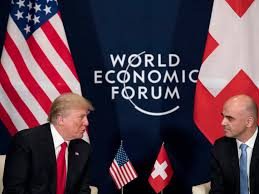
Donald Trump at Davos:
Are We Entering an Entrepreneurial Age of World Politics?
Conflux Eurasia – Eurasian Lens | Trilingual Foresight
This analysis is not about electoral outcomes or personalities.
It is about signals—and what they reveal about the evolving structure of global governance.
1. Trump at Davos: a strategic signal, not an isolated event
Davos is not a governing institution.
It has no legal authority, no treaties, no binding decisions.
Yet it has become a high-density convergence point for political and economic power.
Donald Trump’s engagement with Davos should therefore be read as a substitution strategy, not a return to multilateralism.
During his political trajectory, Trump has consistently deprioritized traditional international coordination channels, including:
- The United Nations as a normative governance platform
- The G7 as a consensus-based leadership forum
- The WTO as a rules-based trade arbitration system
- Alliance consultation mechanisms that limit unilateral leverage
These institutions are rule-heavy, process-driven, and slow by design.
They privilege continuity over negotiation.
Trump’s approach privileges transaction over institution.
2. Is Davos replacing traditional diplomatic channels?
Not formally—but functionally, for some actors, yes.
Davos offers:
- Direct access to political and corporate leaders in the same space
- No binding communiqués or legal follow-up
- Maximum media exposure with minimal institutional constraint
It functions less as a governance forum and more as a global negotiation marketplace.
For entrepreneur-minded leaders, this environment is structurally attractive:
- Influence is exercised through deals
- Power through visibility
- Outcomes through private alignment rather than collective compromise
This is a structural shift in how global coordination occurs.
3. Beyond Trump: the entrepreneurial turn in world politics
The deeper issue is not Donald Trump himself.
The deeper issue is whether entrepreneurial logic is becoming a dominant organizing principle in global politics.
Large US technology companies—sometimes informally described as the “seven wonders” of American tech—now possess:
- Transnational reach exceeding most states
- Control over data, platforms, logistics, and communication layers
- Dual-use technologies with direct civilian and military relevance
Their power is not symbolic.
It is structural, infrastructural, and increasingly geopolitical.
4. When entrepreneurs shape political rules
Entrepreneurial systems follow different assumptions than institutional governance:
- Speed over deliberation
- Control over consensus
- Competitive advantage over collective stability
This produces consequences.
First:
Predictability declines. Institutions stabilize expectations; entrepreneurial systems optimize flexibility.
Second:
Power becomes less transparent. Influence shifts to private contracts, platform dependencies, and technological lock-ins.
Third:
Strategic autonomy becomes a survival skill—especially for mid-sized and export-oriented economies.
5. Europe and Asia: not “between” powers, but beside them
Europe and Asia are often framed as being “caught between” Washington and Beijing.
This framing is misleading.
In reality:
- European and Asian actors are co-architects of the next global order
- Their choices/ future society blue-print on technology, regulation, education, and cooperation will shape outcomes
- Their consumption power represents the most attractive export market that Beijing and Washington are fighting for
The entrepreneurial turn does not eliminate agency.
It redistributes it.
6. Risk management, not prediction
The key foresight question is not:
Will this entrepreneurial world order succeed or fail?
The relevant question is:
How do societies manage risk across multiple plausible futures?
Some futures emphasize platform-based power.
Others reassert regional blocs.
Others move toward partial re-institutionalization after instability.
Strategic resilience lies in preparing for plurality, not betting on a single outcome.
Orientation Note
For professionals, entrepreneurs, and researchers, three implications stand out:
Learning:
Geopolitical literacy, technology governance, and regulatory understanding matter more than ideology.
Career:
Roles that bridge public policy, technology, and international coordination will gain strategic value.
Cooperation:
European–Asian networks built on capability and trust—not alignment—will become increasingly important.
The future is not predetermined.
It is shaped by structured choices.
At Conflux Eurasia, our purpose is to clarify those choices—calmly, independently, and with long-term perspective.
Conflux Eurasia – Eurasian Lens
Trilingual foresight for a plural world